Well Now I *Really* Love the Frog

Gah… 6:30 on a Sunday morning is a ghastly time to be awake. Someone needs to tell my cats that breakfast is not due for another two hours at least.

But since I’m up, I’ll brag on my friend Laura of A Life in Scribbles. She’s an extremely talented artist an has a real gift for comics. She took a blog post that I wrote last month (How I Learned to Stop Worrying and Love the Frog) and turned it into an amazing comic! I’m so honored that she chose my piece to illustrate. Please check it out. It’s very, very cool. Click on the illustration a couple of times to get it larger.

Enjoy!

Scenes From the Coffee Shop

We interrupt this (surprisingly productive) writing time to bring you breaking news. Virgin Galactic‘s second space port is being built right outside my adopted hometown of Las Cruces, New Mexico. It is! Really! I looked on the internets.

I’m sure this is old news to everyone but me. I was just sitting here at my little coffeeshop table, minding my own business when I heard the guy at the table next to me say something about Las Cruces. Now, I always tune in a little more closely when I hear Texans talking about Las Cruces or New Mexico. There are some pretty wild ideas floating around about my dear state. Most notable is the idea that the Organ Mountains are hollow and home to super-secret military underground bases. I once went on a blind date with a Dallas boy who had the inside scoop on these bases. Apparently they were infiltrated years ago and the military is keeping it all hush hush for fear of causing world-wide panic. Who were they infiltrated by you might ask? Spies? Terrorists? Nope, aliens. Snake aliens!

How happy am I to be married now?

But anyway, at least half the time I hear someone mention Las Cruces it’s usually to repeat a conspiracy theory about the government covering up aliens or nuclear waste or lizard people or whatever. After all, my fine state is home to Roswell and people get confused, you know? And while I don’t fault anyone their beliefs, I am a little more Scully than Mulder. So when I heard him mention Las Cruces and spaceship in the same breath, I had a moment of discreet eyerolling. But then I googled. And it’s true, New Mexico is getting its very own space port.

The whole thing makes me kind of proud, but also I kind of wonder what this does to nostalgic view of the desert southwest and, weirdly, what it does to the stories that I have set in New Mexico. If there’s a friggin’ spaceport being built 45 minutes from where your protagonist resides, you can’t just ignore that. This could lead to some pretty cool opportunities.

Or some big headaches. We shall see.

More About Morning Writing

Courtesy of Gordon at After the MFA: How to Write First Thing in the Morning.

For me, writing first thing in the morning is about focus. Years ago, a visiting writer told our seminar that the first thing she did in the morning was the thing she ended up doing all day long. Thus, she chose to start her days with writing rather than emailing forwards amongst her friends.

I’ve noticed that days that start with the internet often have the productivity sucked right out of them. For some reason, the internet can become all consuming for me, and not in a good way. I have squandered hours searching random crap on the internet. And trust me when I say that at the end of the day I am no better off knowing that Beck is a Scientologist or that I can ace the Facebook “Do you know your states?” quiz.

Whereas if I write for an hour or more before I check facebook or google reader, I have a much better chance of avoiding massive time suckage.

The article has a lot of good tips about getting up and getting writing. I suspect it’s not even limited just to writing. If you’re like me and wondering how to be more productive in your day, give it a read. The 4 a.m. wake up time won’t be happening for me, but I can vouch for many of the other tips.

How I Learned to Stop Worrying and Love the Frog

Frog. (v) to frog. The act of “ripping” out already knit stitches by removing them from the knitting needles and unraveling the stitches. In some cases, you merely “frog” a few rows back to fix a mistake. In more extreme cases, one may “frog” an entirely knit sweater to reuse the yarn.

Back when I learned to knit, after I’d made my first uneven garter stitch square thing, I started becoming a perfectionist about knitting. A psuedo-perfectionsist rather. Simply put, I hated to frog and would do just about anything to avoid it. My strategy? To turn a blind eye to glaring errors or dissatisfaction with the pattern. I kept knitting only to end up with an unwearable sweater or a scarf that would get sent to Goodwill.

The reason for this particular bout of crazy was that one of my first overly ambitious projects had been a mohair lace scarf. Being a beginner, I’d made a lot of mistakes and had had frogged to the extent that the yarn had become a frayed mess. The scarf never got made and for the next several years I avoided both mohair and frogging.

About two years and two drawers full of unwearable knits, I was talking about my dissatisfaction with the pullover I’d just completed. The gauge seemed off. The waistline decreases had a few mistakes. It didn’t fit me right. Overall, not good.

“Frog it,” my knitter friend told me. “It’s only yarn. Besides, you can use it for something else.”

And it clicked. Don’t know why it took me so long, but right then I thought, She’s right. It is only yarn. So what if I spent two weeks knitting it if I don’t like it? I went home and frogged the pullover. I raided the unused knits drawer and salvaged yarn from three other projects. For the final liberation, I pulled a wrap off the needles that they’d been on for three months. I’d hated the yarn and was only halfway through. Part of me thought, What are you doing? You’ve spent three months on this, just go on and finish it, but the other part of me slapped that crazy knitter upside the head and began winding the yarn. And that’s how I learned to stop worrying and love the frog.

However, even though I’ve been a writer for longer than I’ve been a knitter (or maybe because I’ve been a writer longer than I’ve been a knitter) I’ve never been able to apply that lesson to writing. When it comes to writing, have the same problems, I don’t want to “frog” any of my stories. This is part of why I handwrite first drafts. The computer seems too final to me and when I handwrite something I know I’ll be rearranging and revising as I’m typing it in. And, in remembering that, I can allow myself to write a shitty first draft. But even doing that, I can get pretty grouchy about having to “give up” any part of a draft that I’ve spent time and energy on.

Today was a good example of that. I spent about three hours in the afternoon working on a draft of a still incomplete story. I recently read Ron Carlson’s book on story writing and am trying to observe his credo — stay in the room — as much as possible. And so this afternoon I stayed in the room. And stayed. And stayed. And I ended up with a good five or six pages. However, I’m also trying to observe Carlson’s other credo about listening to what the story tells you, and I swear to God that at least five or six times I heard the story go, Oh hell no, you aren’t doing THAT. But I persevered and at the coffee shop this evening, I realized that of the five or six pages I’d written, I had maybe three paragraphs that were usable.

I know that’s part of the writing process, and I’ve come to accept that there are entire stories that sometimes just have to get out on the page so that one gem of a line can be used elsewhere. I deal. But that doesn’t mean I can’t be grouchy about it. Anyway, as I was ripping pages of my notepad I thought about how a story is only a bunch of words. They can be rearranged and reused elsewhere. Maybe even in this story, but definitely not as they are and not right now.

I’ve met a few writers who claim to start fresh on each revision by completely rewriting the story from scratch. I envy that. Even though I do a lot of revision, I can’t claim to ever throw out the original draft and start fresh. I envy the writers who can, though, and I wonder if it wouldn’t be a good exercise to rewrite one of my more complete stories without ever referring to the original or even the latest draft. Could be interesting.

So why not try it? It’s that part of me, that crazy knitter part from before, who is thinking, My god, what a waste to completely undo everything that you’ve worked so hard on. Leave it alone!

I think it’s time to slap that crazy knitter upside the head.
Things I Should Have Read in Grad School

Sometimes you’ve just got to surrender to the season. I’m a writer in need of a strict routine and when it gets broken or interrupted, I’m pretty much useless. So for the next few weeks I’m switching my focus to reading and studying other writers, namely writers that I probably should have read years ago.

Since I started reading books about writing, I’ve realized how much of my cannon is sadly lacking. I’m still not sure how I made it through a three-year MFA program without reading “The Dead” or D.H. Lawrence or John Steinbeck or Moby Dick for that matter. Every time someone sends me a 100 Greatest Books Ever meme I feel like someone should revoke my MFA.

Well, no more. Over the holidays I plan to not only do some fun reading (The Uses of Enchantment and The Wind-Up Bird Chronicle) but to beat my way through the list of books on my “I should read this” list.

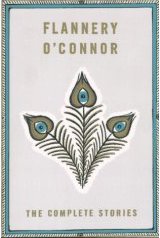
Today was all about Flannery O’Connor: “Geranium,” “The Life You Save May Be Your Own,” “The River,” “Everything that Rises Must Converge,” “Revelation,” and “Judgment Day.”

I don’t think you can make it through a college freshman composition course without reading “A Good Man is Hard to Find” or “Good Country People,” but the rest of her stories are usually left for more avid readers, O’Connor fans, or literature majors. It’s a shame, but it’s not hard to figure out why. O’Connor’s stories are not for the faint of heart. The characters are sympathetic, but difficult to like. I read a passage from “Revelations” to Hubs, who promptly retorted (about the character), “Wow, what a bitch.” Exactly! And yet, still sympathetic. It’s a mystery to me.

I’ll leave the analysis and the academic review of these stories for the more skilled. The things I took away from them were probably not revelations to anyone but me. Anyway, I was struck by the language O’Connor used to create these worlds and characters. In “The Geranium” she writes, “People boiled out of the trains and up steps and over onto the streets. They rolled off the street and down the steps and into trains – black and white and yellow all mixed up like vegetables in a soup. Everything was boiling.” That paragraph stayed with me, not just for it’s electricity, but because it’s a great (and obvious) example of using an image to depict a character’s point of view. I was overwhelmed just reading that paragraph, which is how I would expect the protagonist (an elderly man from the country) to react to the New York City subways as well.

I also admire O’Connor’s willingness to create ugly characters. Most of these stories dealt with a character with some physical abnormality. Those that are more intact physically are at least overweight or “plain.” This is something I struggle with in my writing. I’m usually a little afraid to create an ugly character and in the all the workshops I attended, I recall only one story where a character was homely and that definitely wasn’t the protagonist. I think we aspiring writers could all take a lesson from this and try creating a protagonist that is at least a little ugly. (Hmm… I sense a writing exercise here.)

There’s so much more to take away from Connor’s short stories. I’m glad I finally branched out beyond the usual stories. I’m sure I’ll be returning to these stories for years to come to learn how to handle character, structure, place and so much more.

Writing Exercise: Lies

I’m back from spending an awesome weekend at a tiny Texas bed and breakfast. The women of my family have made this an annual trip and I can’t tell you how good it is to get away from everything for a weekend.

But it’s back to work now and time for my first weekly writing exercise. Over the weekend I read Antonya Nelson’s “Or Else” from the New Yorker. Amazing story. I finished it and immediately flipped back to the beginning to read it again.

After reading, I was reminded of a character from David Benioff’s The 25th Hour who claims to be the true author of a very famous poem. In his story, he had authored the work, but it was stolen by a colleague who then got all the credit and fame for it. This turns out to be a lie, but one that is humored by the character that actually knows him.

There are tons or writing exercises about lies out there, so I’m going to start out with something fairly general. Write a scene in which a character tells an elaborate lie about his/her life. 1000 words.