From the “I Wish I’d Written This” Department:

Margo Rabb’s “How to Tell a Story.”

Even though it’s not possible that Margo and I were in the same MFA program, this story feels so true to my experience (right down to the sentiment/sentimentality lecture) that I wouldn’t be at all surprised to find out that she was sitting right next to me all that time.

I discovered the story years ago, just before my third year in the program. I thought it was so dead on that I sent copies to classmates with the subject line, “OMG! Is she talking about us?!” In the years since, it has served as a reminder that I’m not the only person who had an F’ed up MFA experience. There are plenty more of us out there, and God Bless us all for surviving it.

Linkage: What Makes Bad Fiction

Ward Six writer J. Robert Lennon recently posted a list of what makes fiction bad (in his opinion) and invited others to share their complaints. I tried coming up with my own list of complaints, but could only think of one:

Fiction that puts artiface or style over the story. There’s a book I started reading recently that had an unusual narrator. That part didn’t bother me, but this narrator was frequently interrupted by vague poetic observations that were usually written in ALL CAPITAL LETTERS. These observations were so intrusive, they kept pulling me out of the world of the story and reminding me that the author was trying something very clever. I hate that. I like to be lost in a story. I like to forget that a novel even has an author, so if the story is mainly a conduit for the style (instead of vice versa) it’s going to leave me cold.

Anyway, I encourage both readers and writers to check out the original list and the discussion that follows. I think we can all benefit from being able to talk about why we don’t like a novel or story instead of simply saying that we didn’t like it.

The Freshman Fifteen

I am fifteen again today. Seriously. I have regressed into a slouchy, pimply-faced adolescent all because of a box of books. And I am loving it.

A few weeks ago I noticed that the Sweet Valley High books are being updated. Now, the Sweet Valley High books didn’t do much for me. My high school experience did not involve being pursued by beautiful boys and wondering if I would get a Fiat for my birthday. I was home more Friday nights than not and so I couldn’t really relate to the Wakefield twins and their glamorous lives.

My teen series of choice were the Freshman Dorm books by Linda A. Cooney (or the several writers that were Linda A. Cooney). The series has the usual soap-operatic dramas (will Faith stay with her high school boyfriend or find a new love? What secret is party girl Winnie keeping from her friends?) but was also based in a down-to-earth view of college life. Or so I thought at the time.

When I heard about the reissue of the Sweet Valley books, I got a pang for my own brain candy and two weeks and a couple of eBay searches later and the Freshman 15 was at my doorstep – the first fifteen books of the Freshman Dorm series.

Ah the memories… I was totally enamored with college life when I read these. The U of S campus seemed so glamorous. There was a lake on the campus! There was an artsy dorm and a jock dorm! People fit so neatly into their categories (with the exception of Melissa, Winnie’s jock roommate, who accidentally gets placed in the party dorm — oooh drama!). People even dressed according to their major. KC, the finance major, is always in a blazer and knee-length skirt.. Kimberly the dance major makes her first appearance in (wait for it. . .) a leotard and tights!

I spent this weekend reading the first of the series and giggling with glee over all the drama that ensues during the first week of college. Forget the Sweet Valley High and the Gossip Girls, this is a series that needs to be brought back. The books ahead promise secrets! lies! betrayal! flames! weddings! more betrayal! Okay, so realistic it is not, but the reading is such fun brain candy.

If there’s anyone out there in the blogisphere who knows of a planned Freshman Dorm comeback, I am your Linda A Cooney.

Operation Domesticity

We interrupt this writing day to bring you … bread.

A few months back, I decided to put my domestic skills to the test and bake a loaf of bread. But, even I know that my domestic skills suck, so I went with the easiest bread recipe ever. The results were okay. It was tasty, but my bread ended up much less substantial than expected and, frankly, a little airy and chewy. That, however, did not stop Hubs and me from eating every last crumb.

When I mentioned that I tried the recipe, my friend Karin told me that Cook’s Illustrated had improved it and so I proceeded to badger her for a copy until she finally brought it last week. Turns out it’s available on the internet. Whoops.

So, feeling the urge to be domestic again (and looking for any excuse to avoid a painful revision), I decided to test the 2.0 recipe. The result was much better. Not at all airy and completely substantial. It had more flavor and the crust was slightly thicker and crispier, which is just the way I like it. From now on this will be the recipe I use to impress people with my mad baking skillz.

Here’s what you need:
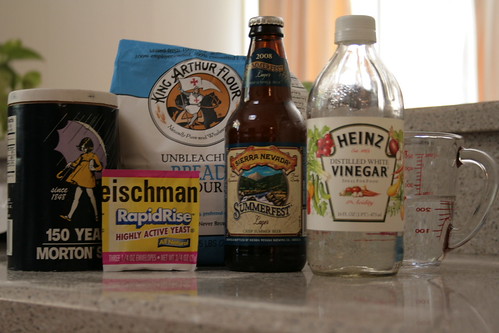
A couple of modifications on my part. First, the Cook’s Illustrated version calls for all-purpose flour, but why use all-purpose when you have bread flour? I’m not sure there’s that much of a difference, so if you only have all purpose on hand, use it.

Second, the recipe suggests using Budweiser for your mild-flavor lager. I’m not much of a beer drinker, but I simply will not buy Budweiser. Too many bad college memories. I chose the Sierra Nevada Summerfest Lager. It wasn’t bad, but I’m open to suggestions.

Here’s how ridiculously easy the recipe is. Once you’ve gathered everything up, mix up your dry ingredients in a large bowl and then pour in all your wet ingredients and combine until you have a shaggy ball of dough. So easy. After that, cover the bowl with plastic wrap, finish the rest of the beer, and wait 18 hours. At this point, I probably should have gone back to the revision, but instead I read a book.

Anyway, the rest of the recipe is just as simple as the first part. Place a sheet of parchment paper in a shallow skillet (I used my Lodge 10-inch skillet) and lightly spray it with cooking spray. Then remove the dough from the bowl and knead it into a small ball. Put the ball in the skillet, cover with plastic wrap, and wait another two hours.

With all this waiting you would think I could be doing a lot of writing. You would think that, wouldn’t you? You’d be wrong.

About 30 minutes before you’re ready to bake the bread, set your oven at 500 degrees and put your dutch oven in to heat up. The recipe suggests using an enameled cast iron, but I used my trusty Lodge. Then find every potholder you ever owned and get them ready. You’re going to need them. After the pot is heated, transfer the bread to the pot by using the parchment paper. Genius idea, really. Just don’t burn yourself. Then reduce the heat to 425 and bake with the lid on the dutch oven for 30 minutes. Remove the lid and bake for another 20 minutes.

Using your gazillion potholders, remove the bread from the oven and let cool on a wire rack.

And here is were I worry that the Cook’s Illustrated editors are smoking crack. You’re supposed to let the bread cool to room temperature for about two hours. Two hours!? Seriously? Have you smelled warm bread? Do you think it’s possible to resist the craving to taste warm bread once you have smelled it. Let my clue you in, it isn’t. Wait as long as you can, but I only lasted 10 minutes

That small disagreement aside, I think this recipe is a huge improvement over the New York Times version. Very tasty and much less complicated. (Not that the NYT version was complicated, just that this one is so much easier.) Also, cleaning up for this recipe means washing one bowl. That alone is enough to win my loyalty.

A note about the beer. When I first read the recipe, I was concerned about the beer addition. My mother occasionally makes beer bread and the combination is just not my thing. I was pleased to note that this bread was not beery at all, but that the beer did seem to boast the flavor. You can use non-alcoholic if you so choose.

So Operation Domesticity was a success this time around. Operation Revise that crappy story, not so much.

Source: Cook’s Illustrated.

Linkage: Why Writers Can’t Go It Alone

(via Matt Bell)

This Guardian article gets a big amen from me:

The literary world only bestows acceptance, it seems, on those who are published through the traditional avenues. Independent and small presses get short shrift – national newspaper supplements seem loath to review indie books, the big high street sellers won’t stock them, unless the books are about the tough lives of mill girls or histories of public house names, which can be shoved on a shelf marked “local interest”.

<…snip…>

But there’s a sea of dross in the worlds of pop music and movies, too. Quality rises to the surface there, so if the literary industry can relax its perceived inherently snobbish attitude to the output of anything other than the established, traditional publishers, perhaps the same will happen with independent, small press and even self-published books.

Someday I’ll be brave enough to publish my rant/bitch/whine about the stigma of self-publishing in the literary writing world. I think it’s becoming clear that in the current book market, traditional venues are losing ground. In the meantime, read the The Guardian’s take on the subject.

Living in a Powder Keg and Giving Off Sparks

Hubs finally got a Playstation 3 last weekend. I say finally because before we started dating, the man had aspirations of getting a PS3. Three years ago he bought his entertainment center specifically so it could eventually house the PS3. But all the fun in shopping for Hubs is spending years looking for the best deal and agonizing over whether the price will drop or a new version will be released and so he waited and waited and waited. Well, the wait was over last weekend when he decided that there wasn’t going to be a better deal before Christmas time and his desire to play Lego Indiana Jones and Assassin’s Creed outweighed the need to wait for another price drop. He came home on Sunday night with both the PS3 and the Indiana Jones game.

So of course, I ran out the next day and bought SingStar.

For those of you who are not familiar with the goodness that is SingStar, it’s essentially a karaoke video game. You sing along with the song and score points for timing and pitch. All the while, the music video plays in the background. The game is so friggin’ addictive that we already have SingStar 80s, SingStar Rocks, and SingStar Pop for the PS2 and SingStar for the PS3. We need help, people.

But by and large, the most fun thing about SingStar is the WTF?! factor of some of the lyrics and videos. To that end, I submit Bonnie Tyler’s “Total Eclipse of the Heart” video. Now, keep in mind that I came from a household that did not have MTV until the 90s. The only videos that I got to see were the ones that eventually made it onto NBC’s Friday Night Videos and I’m pretty sure I never saw that one because when we played the Bonnie Tyler song, I lost 2000 points simply because I could not stop laughing. Ninjas, high school swimmers and some freaky angel looking guy… this video has it all.

Enjoy.

P.S. My utmost respect to whomever can tell me what that video is supposed to be about.

Memeage: The Magic MASH Machine

I am so thankful for my wonderful friends who find glorious online time wasters and share them with me. Today’s find: The Magic MASH Machine.

For those of you who were not blessed with playing MASH in junior high (i.e. boys), it’s a wonderfully silly game where you list all your crushes (plus one or two duds), all your dream jobs (plus one or two duds), all your car choices, kid choices, dream city choices, etc. and then wait for the hands of fate to determine your future. And by hands of fate, I mean, the girl that sits in front of you in Social Studies who counts out the answers and who may or may not be cheating thereby making you end up married to the class clown, Sammy Melcheck, instead of to Alan Peterson, for whom you KNOW you are truly destined.

Ahem. . . No hard feelings, Laura.

Anyway, there is now an online version of the hands of fate. I believe it only slightly less biased than Laura Dyer. My results:

You will marry Freddy Rodriguez. [1]
After a wild honeymoon, you will settle down in Deluth in you fabulous Apartment.
You will have 0 kid(s) together.
Your family will zoom around in a Seafoam Green Chevy Nova.
You will spend your days as an Acclaimed Air Guitar Champion, and live happily ever after.

If you are so inclined, leave your fate in the comments.

________________
[1] It totally came down to either Freddy or Meatloaf. Whew!

Linkage: “Confessions…”

Via Jade Park: “The confessions of a semi-successful mid-list author

If you don’t want to hear about the noir underside of publishing — if you’re a writer longing for a literary career, or a reader who’s happier not knowing that producing and marketing a book these days involves about as much moral purity as producing and marketing a pair of Nikes — I suggest you stop reading now.

The above linked article is not a cheerful read. I’ve had a long rant coming on the publishing industry, the death of reading, and the stigma of self-publishing. I’ll see if I can’t get that up in the next week or so.

Wrestling with the Real Writers

My productivity last week centered on typing the first draft of a story I wrote last month. I write longhand. My very first writing teacher said that was a huge waste of time and thus began a long string of advice from writing teachers that I have ignored.

For me, writing longhand is soothing. There’s something about putting pen to paper that allows me to shut off the editorial noises in my head and just write. Typing is for revising and editing. But most importantly, notebooks do not have the Internet and so I can’t click off my story and onto Facebook or Good Reads or chat or any of the other million ways the Internet tempts me to not write.

It’s probably a good thing that most of my work is taken up by mere typing because last week kind of sucked as far as creativity goes. It seems I have some demons to deal with and I’ve been facing them pretty much anytime I sit down to write.

My MFA program cultivated a certain amount of elitism amongst its writers. Between the 40 or so of us in the fiction program, there were unspoken guidelines about what made you a “real” writer[1] as opposed to someone who would leave their MFA and go work in technical writing for the rest of their lives. (Since I have already lost my “real” writer status by doing just that, you’d think I have nothing else to lose.) Real writers, for instance, wrote literary stories. They were usually about drugs and sex and parents and death. The stories were edgy, sometimes violent, and usually involved taking drugs at 12, midgets, monkeys, and other extraordinary elements. They read Borges and Lovecraft and nothing else published after 1975. They didn’t come to readings because they were too busy writing (or thinking about writing while down at the bar). Generally, a lot of the stuff they wrote was very good.

If you didn’t fall into this category, they didn’t quite know what to do with you. When I started the program, I tried desperately to fit into this category. But I developed my love for reading and writing through contemporary fiction and (cough, cough) chick lit. I didn’t grow up with drugs or violence and the story I most enjoyed writing was the anti-love story. In the autumn of my first year of the program, one of the “real” writers who was in her last year at the program suggested I look into romance writing. She did so after she’d sat in on one of my workshops and in a tone that left no question about how little she thought of my work.

I went home, cried for a little while, read through my New Yorkers and Best Americans and resolved to write a better workshop story. I don’t think I ever earned the approval of my peers, but I improved my sentences and my characters. I became a better writer, even if what I was writing wasn’t what I loved. In the end, I liked the stories I was writing and I thought I was doing a pretty good job at them.

And now? I was at a reading a few months ago for the winner of a local short story contest. As the first place winner read, I grew increasingly annoyed. There was the down-and-out protagonist. There were the drugs. There was the fantastical event that existed more in obscure imagery than in clarity. It wasn’t a bad story, it was just the exact same story that I’d spent three years reading in the program. And the epiphany here is more about me than about the story I was hearing: I am simply not interested in the literary genre anymore.

The struggle comes, though, that literary writing is pretty much all I’ve ever known. Prior to the MFA, I had three stories in my name, one of which, I still work on from time to time. I’m having a hard time letting go of what I should be writing and focusing on what I want to write. Of course, the minute I start thinking about what I want to write, I find myself drowning in my own prejudices and elitism.

I’m starting small, but I’m changing that. Last night at the bookstore I bought a couple of books that looked good. They aren’t on any literary lists. They will probably not win any major awards. But dammit, I’m going to start reading what I enjoy again. With any luck, it won’t be a long path back to what I enjoy writing.

___________________
[1] For the record, I hate the term real writer. Do you write? Then you’re a writer. I have no idea what qualifies you to be real.

Copycat

I’m reading Joan Didion’s Slouching Towards Bethlehem right now. By reading, I mean I’m devouring every sentence and every word. I love her style.

On a similar note, I’ve been thinking a lot about reading for language and style vs. reading for story and character. I think there’s value to both. My mind defaults to reading for story and character more so than language and, unless the writing really catches my attention (as Didion’s does), I usually have to remind myself to look closer at the language in the prose I read.

One of the teachers in grad school suggested that we hand write passages or entire stories that we liked to get a sense for the style of the piece. It was not enough to simply read it, he said. He encouraged us to get a feel for the cadence of writing the story. In a notebook somewhere I have entire handwritten copies of “How to Talk To a Hunter,” “Lust,” and “Sonny’s Blues.” It may sound like busy work. I recall one of my classmates rolling his eyes and arguing that he barely had enough time to write his own stories, let alone someone else’s. But I had enough time. And I’d argue that I became a better writer for it because it made me pay very close attention to language in a way that I didn’t when I was reading.

I came across a great quote by Julie Kramer that may speak to this: “If authors have to write half a million words before they get published, I’d venture that they have to read ten million.” The next time you read something really outstanding, try pulling out your notebook and copying a paragraph or two. If you’re really ambitious spend some time re-writing your favorite story. See if it doesn’t draw your attention to the finer details of the prose.